


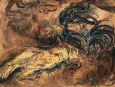




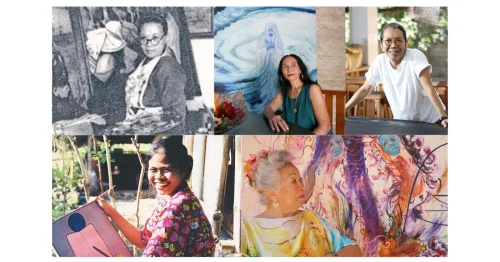
In the male dominated art world, many are unaware of women artists. Often, their works are featured in galleries yet many do not know that women are behind these works. This is especially prevalent in Indonesia due to the patriarchal norm. Hence, to commemorate women’s day that is held on the 8th of March every year, here are five Indonesian women artists who are renowned for their talent, strength, and stories.
Emiria Soenassa (Born in Tidore, eastern Indonesia, 1895 | Died in Lampung, South Sumatra, 1964)
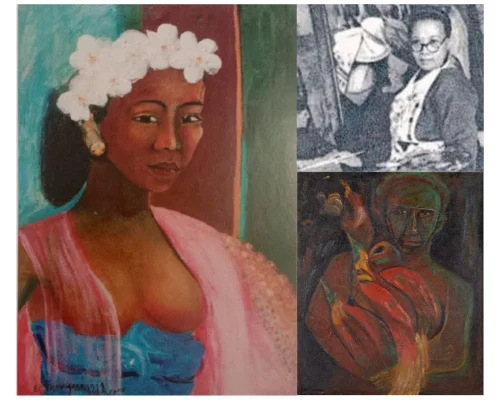
Considered as Indonesia's first female painter, she is known as someone who introduced a new style to the male-dominated way of painting at the time. Despite loving to paint as a child, her passion was not supported by her parents. Hence, she is self-taught and only began painting seriously after the age of 40.
Her paintings are heavy on diversity, visualizing the people and landscapes of various islands. What sets her apart is how she painted women with eyes that look straight instead of looking down, reflecting her free and independent spirit, which was unlike other paintings back then.
Aside from her works in art, she has also worked in various fields. She had been a nurse, secretary, an administrator, and even attended the Round Table Conference of the United Nations in 1949 in New York as the symbolic leader of the people of Dutch New Guinea. Moreover, she joined the Persatuan Ahli Gambar Indonesia (Persagi), which is the first nationalist-oriented organization of draftsmen and painters. There, she became an active painter and held her first exhibition in 1940. By 1943, she became the only woman artist who had a solo exhibition in Pusat Tenaga Rakyat (Poetra) in Jakarta and had another one in 1946 with around 50 pieces. Her exhibitions were highly regarded, with many saying it is comparable to artists’ such as Affandi, Kartono Yudhokusumo, and Basuki Abdullah.
Kartika Affandi (Born in Jakarta, 1934)
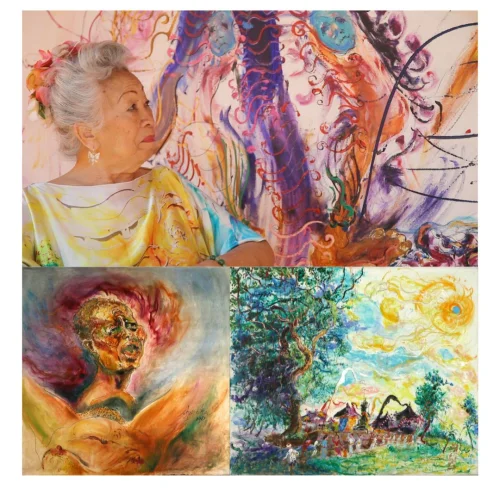
Taught by her father, Affandi, Kartika has loved to paint ever since she was young. She often paints people, landscapes, and her journeys in various countries. Moreover, she would paint self-portraits to signify the turning points in her life. Although her paintings showcase the similar spiraling strokes as her father’s, their works are distinguishable as hers are less curly.
Having married young at 17 but later on divorced, she wondered whether a woman’s role was to only bear and raise children, as well as taking care of the family. She questions whether there is anything else a woman could possibly do. Therefore, she protested the idea that women are not supposed to excel and show emotion, which is portrayed in her works. She dreams that one day, there would be a place for art made by women.
Dolorosa Sinaga (Born in Sibolga, North Sumatra, 1952)
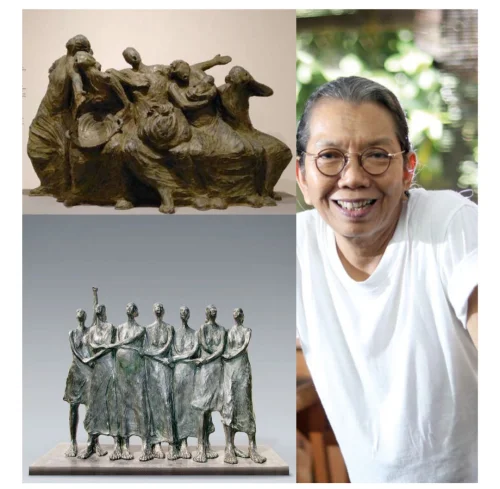
Known as a prominent Indonesian sculptor, Dolorosa prefers to work with bronze in order to portray the issues or difficulties that women face. She describes sculpting as an act of tension, allowing her to create expressive figures that convey the stories of different periods and stages of life. In her works, she made sure to represent both the suffering and joy that women face.
Aside from being a sculptor, she is also prevalent for her involvement in theater, film production, and various social causes such as the protection of children and support for women’s rights. Due to this, she is known to have always rebelled against the conventional norms and has developed a strong social conscience.
In one of her works titled “Will Find My Way”, a woman is seen carrying a bag with determination. In a sense, the piece represents a woman’s transition from being vulnerable and helpless, which is how they are seen in society, into someone who is strong and is able to create their own paths. It shows how despite suffering, there is still power to be acquired and used.
I Gusti Ayu Kadek Murniasih (Born in Jembrana, Tabanan, Bali, 1966 | Died in Ubud, Bali, 2006)
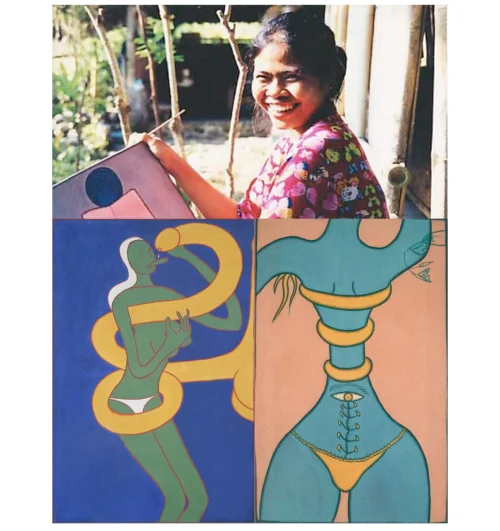
As an artist who went through many traumas ever since she was a child, Murniasih did not deal with the pain through anger, but through art. She painted what she experienced or imagined with wild and distorted body parts. By using explicit imagery of her own body, she felt as if she had regained her body back for herself, especially since she was sexually abused by her father. Her works also symbolize how a woman’s body is treated within society and explores the complexity of a woman, such as their desires and fears which are usually repressed by social constructs, as well as themes regarding objectification. To her, painting makes her feel as if she exists.
Due to this, her works are statements of women’s struggles, and have shocked the conventional art world, especially where she was from, as her works not only challenge the usual aesthetics, but the existing norms as well.
Today, she has become the first Balinese artist whose works are collected by Tate Modern Gallery, which is one of the world’s largest and most prestigious museums of modern and contemporary art. She was also invited to joint and solo exhibitions such as at Seniwati Gallery, Cemeti Art House, and Nadi Gallery. Her art has then travelled around the world, such as Germany, Hong Kong, Italy, Netherlands, Japan, Spain, Cambodia, Thailand, the United Kingdom, and Australia.
Lucia Hartini (Born in Temanggung, Central Java, 1959)
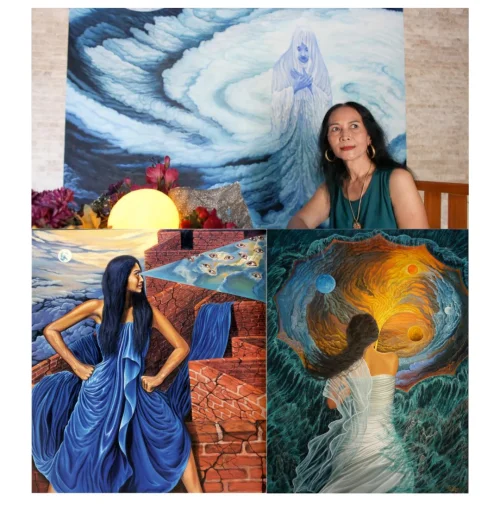
As one of the first nationally acclaimed women artists to capture international attention in the 1990s, Lucia is known for her love in painting landscapes combined with imaginary themes. As a child, she is seen as a dreamer who often imagines various scenarios while strolling along the village. As an artist, she brings this trait onto her art which allows her to showcase her life experiences and inner yearning for peace.
Many of her works involved women as the subject. As a woman herself, she is aware of the pressure coming from a patriarchal society. This was especially prominent when her husband left her with two children, making the public look down on her for being a woman who is deserted by her partner. Hence, many of her works represent how she felt during these moments and also depicts women in a strong sense, such as showcasing their power or muscles, to symbolize the independence and strength that is present in each of them.
---
Aside from these five women, there are numerous other Indonesian women artists who each have their own artstyle, specialty, and experiences. Despite many challenges, they constantly create art which holds various meanings. Through this, they showed that women could do anything and are free to express themselves. Hence, their works, achievements, and stories are worth celebrating and remembering.